UC Admit Rates: South Bay and Cupertino Corridor High Schools
Did you know? Cupertino High had a higher UC admit rate last year than Monta Vista — and a higher UC admit rate than Lynbrook.
Cupertino High's UC admit rate in the most recent published cycle: 41 percent. Monta Vista: 39 percent. Lynbrook: 36 percent.
Take a moment with that. Monta Vista and Lynbrook are schools Silicon Valley families move across city lines to attend. They're the ones that show up in the competitive parent whisper networks, the ones that generate the anguished posts on neighborhood Facebook groups every spring. And yet Cupertino High — also a Fremont Union school, sitting right next door — had the highest UC admit rate in the corridor.
This is, without question, the most counterintuitive set of numbers in our entire Bay Area series. And if you're a Monta Vista or Lynbrook parent right now, we see you. So before we go any further: this is not bad news for Fremont Union families. We promise. By the end of this post you'll understand exactly why these numbers look the way they do — and why they don't mean what you might think. You're a parent and you deserve the actual data, so here it is.
This is the fourth post in our regional series. Each week we're walking through one Bay Area region, reviewing the public and charter high schools, and explaining what the UC numbers actually say. Today: the South Bay and Cupertino Corridor — Fremont Union High, Mountain View–Los Altos Union, Los Gatos–Saratoga Union, and Campbell Union High schools.
One note before we get to the table: this data covers public and charter high schools only. The prominent private schools in this region — Bellarmine College Preparatory, Archbishop Mitty, Notre Dame San Jose, Sacred Heart Preparatory, Saint Francis High in Mountain View, The Harker School, and Presentation High — are not included. UC suppresses school-level data when fewer than five students apply from a given school at a given campus, which effectively excludes most private schools from the published dataset. They send real numbers of kids to UC, but we can't compare them here.
Ten South Bay / Cupertino Corridor public high schools, ranked
This is every public high school in this corridor we have UC data on, ranked by UC admit rate in the most recent published cycle (Fall 2025 — kids who started college this past fall).
| School | District | City | UC Admit Rate | Applicants |
|---|---|---|---|---|
| Cupertino High | Fremont Union High | Cupertino | 41% | 2,476 |
| Monta Vista High | Fremont Union High | Cupertino | 39% | 2,767 |
| Prospect High | Campbell Union High | Saratoga | 39% | 808 |
| Lynbrook High | Fremont Union High | San Jose | 36% | 2,508 |
| Homestead High | Fremont Union High | Cupertino | 35% | 2,396 |
| Los Altos High | Mountain View–Los Altos Union | Los Altos | 35% | 2,083 |
| Saratoga High | Los Gatos–Saratога Union | Saratoga | 34% | 1,717 |
| Mountain View High | Mountain View–Los Altos Union | Mountain View | 34% | 2,004 |
| Fremont High (Sunnyvale) | Fremont Union High | Sunnyvale | 34% | 1,201 |
| Los Gatos High | Los Gatos–Saratoga Union | Los Gatos | 31% | 1,690 |
A few things probably jumped out:
- Cupertino High tops the list, even though most families in this corridor would rank it third or fourth among Fremont Union schools in prestige. It beat Monta Vista by two points and Lynbrook by five.
- Prospect High — a Campbell Union school most South Bay parents rarely mention — tied Monta Vista at 39 percent. With 808 applicants, it's a much smaller pool, but the rate is real.
- The five Fremont Union schools cluster in the top five slots (Cupertino, Monta Vista, Lynbrook, Homestead, Fremont High in Sunnyvale). As a district, Fremont Union sends enormous numbers of kids to UC — and yet the admit rates span from 34 percent to 41 percent within that single district.
- Saratoga High lands at 34 percent, which will surprise many families who consider it one of the most academically competitive schools in the Bay Area. Los Gatos High, at 31 percent, is lowest on the list.
- The entire list spans only ten percentage points — from 31 percent to 41 percent. This is a very compressed range, which tells you something: the whole corridor sends kids who are at or above the UC bar. What's shifting the admit rate up or down at each school is more subtle than raw academics.
This is real. It's also not what most families in this corridor assume. So let's talk about why.
Why the "good schools" admit rates are lower
Here's the thing UC does that most rankings don't: they read every application in context.
When a kid applies to UC from Monta Vista or Lynbrook, UC sees the school profile. They see that these schools offer 20 to 30 AP courses. They see that the average senior took 4 to 7 APs. They see that nearly every senior is college-bound, that most have parents with advanced degrees in tech, law, or medicine, and that the families in those neighborhoods spend years preparing their kids specifically for elite college admissions. UC reads the kid's transcript against that environment.
When a student applies from Cupertino High, UC sees a Fremont Union school with strong AP offerings — but a slightly more variable applicant pool, a somewhat broader range of post-high-school plans among the senior class, and a student body that's slightly less uniformly elite in parent education level than Monta Vista's. UC reads that kid's transcript against that environment too.
It's not that UC is grading Monta Vista kids harder. It's that UC is asking: did this kid maximize what was in front of them? At a school where most classmates are taking five or six APs and the expectation of UC attendance is baked in from eighth grade, "maximizing" means something different than at a school where strong students stand out more from their peers. At a school where a majority of parents hold graduate degrees in STEM and have been building their child’s academic resume since middle school, a perfect GPA carries a different signal than at a school where it's slightly less universal.
The math of it: when you take a high-performing applicant pool from Monta Vista or Lynbrook — where most kids far exceed the basic UC bar — and run them through holistic review where the school's strong profile is "expected" rather than "exceptional," the admit rate compresses. When you take a slightly more variable applicant pool from Cupertino High, where strong applications stand out a bit more relative to the school's profile, the admit rate stretches.
This is not bad news for Monta Vista and Lynbrook families. It's actually how UC has worked since 1996, when California banned race-based admissions and UC leaned harder into family income, school profile, and first-generation status as the things they could legally consider. Holistic review means context matters — and the context at Monta Vista is extremely high-pressure in every direction.
What about kids actually getting in?
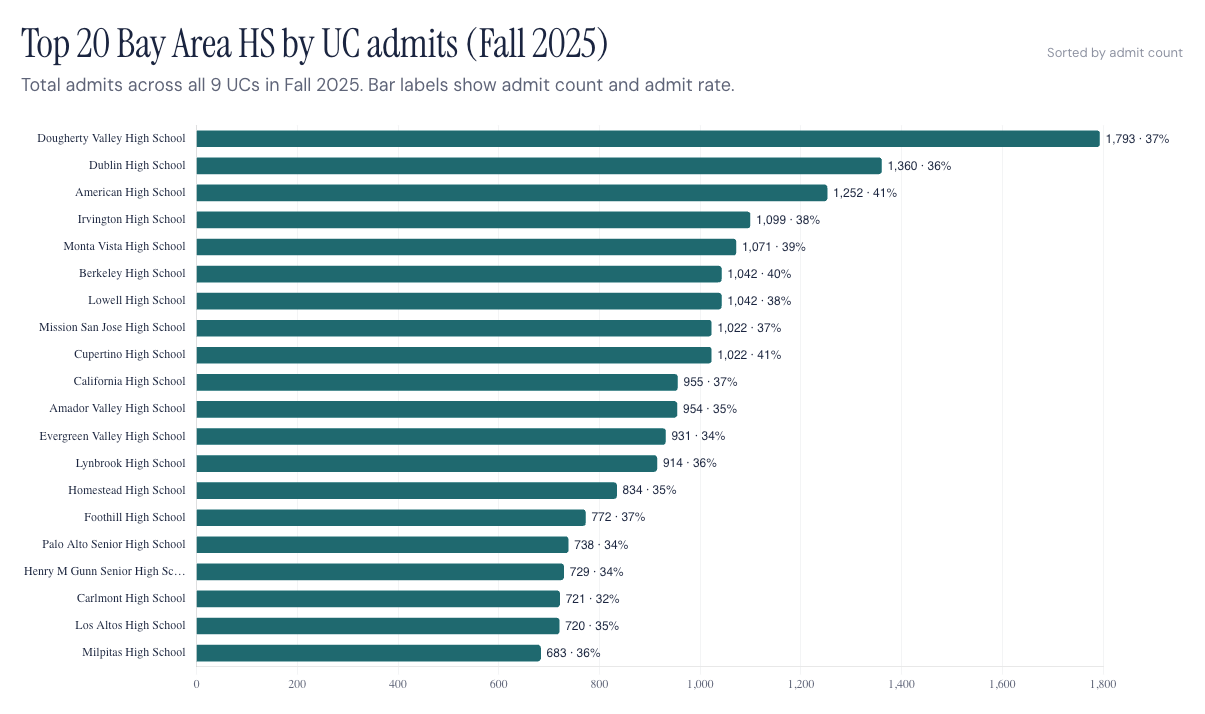
Here's a number that does not show up on the rankings list. Monta Vista sent roughly 1,072 kids to a UC last year. Cupertino High sent roughly 1,016. In absolute terms, those are almost identical. Lynbrook sent about 912. Homestead sent about 832.
Monta Vista has the highest raw count of UC admits in the entire corridor — more than Cupertino High, more than Lynbrook — precisely because it has the most applicants. Saratoga High sent about 584 kids to UC. Los Altos High sent about 721.
The schools with the biggest applicant pools are still sending the most kids to a UC, full stop. The admit rate differences reflect the composition and competitiveness of the applicant pool, not the ceiling on what any individual student can achieve. If you're a Monta Vista parent and your kid is in the top half of the class, takes hard courses, and writes a thoughtful application, the math is still very much in their favor. The rate is just compressed because their peers are so uniformly strong.
What this means for your student
If your student goes to Monta Vista High or Lynbrook High: the admit rate at the school is not your kid's individual admit rate. UC reads each student against the school's own profile. Top of the class with strong courses and a real application — they have great chances at multiple UCs. Don't let the school's average rate make you panic, and don't let it make you over-apply to safeties. The 36-to-39 percent rate at your school is mostly a story about the extraordinary strength and concentration of the applicant pool, not about your kid's chances individually. Students from Monta Vista and Lynbrook are still getting in.
If your student goes to Cupertino High or Homestead High: this data is genuinely encouraging. Your school is producing admit rates at or above the more famous Fremont Union names. UC reads your kid's profile in context — being a standout at Cupertino High is a meaningful signal. Don't let anyone tell you a Cupertino address is second-tier.
If your student goes to Saratoga High or Los Gatos High: the rates here — 34 percent and 31 percent — sit just below the Fremont Union cluster. Saratoga High in particular has an extremely rigorous academic environment, which means UC reads that context very carefully. A 34 percent rate at a school with Saratoga's academic intensity isn't the same as a 34 percent rate at a school with a more varied applicant pool.
If your student goes to Los Altos High, Mountain View High, Prospect High, or Fremont High in Sunnyvale: all four of these schools are sending solid numbers of kids to UC at rates between 34 and 39 percent. Prospect High is a name that rarely comes up in South Bay parent conversations about UC, but 39 percent is an impressive rate. Mountain View High and Los Altos High each have over 2,000 applicants — these are substantial pipelines, not exceptions.
For everyone: spend ten minutes with your child’s actual school in our UC dashboard. Look at the year-over-year trend. Look at which specific UC campuses your school sends the most kids to. That's a much better list-building starting point than neighborhood rankings or which district everyone says is "the best."
A few honest cautions
These are average rates, not your child's odds. UC reads each application individually. The same school's top-quarter and bottom-quarter students have very different admission chances. A 41 percent school-wide rate doesn't mean 41 percent of the senior class is getting into UC — it means 41 percent of the students who chose to apply got in.
Private schools are not in this data. Bellarmine College Preparatory, Archbishop Mitty, Notre Dame San Jose, Sacred Heart Preparatory, Saint Francis High in Mountain View, The Harker School, and Presentation High are all excluded from this dataset. These schools send a real number of kids to UC, but the UC Information Center suppresses school-level data when fewer than five students from a given school apply to a given campus. We're planning a separate post on Bay Area private schools.
Year ranges matter. The numbers here are for the most recent published cycle, students who started at UC in fall 2025. UC publishes this data with about a 12-month lag, so this is the freshest school-level data available.
The spread within this region is genuinely narrow. Thirty-one to 41 percent is a tight range for ten schools. The ordering can shift by a point or two from year to year — don't read too much into the precise rank of any one school.
Explore the full dataset
Every school, every UC campus, every year from 2019 to 2025 — filterable by county, city, and school — is in the dashboard page.
Coming next Thursday
San Jose. Mount Pleasant, Andrew Hill, Yerba Buena, Overfelt, Leland, Willow Glen, Pioneer, Branham, Evergreen Valley, and more. Same approach: every public high school, every UC, with the warm explainer for what the numbers actually mean.
Want help making sense of this for your kid?
Ready to build your student's plan? StrivePath offers personalized academic and college advising for Bay Area students from 7th grade through senior year. Book a free consultation with our team today.
👉
mystrivepath.com — StrivePath: Happier students. Less stressed families. Better admission outcomes.
Sources
- UC Information Center — admissions by source school
- UCOP Fall 2025 Admissions Summary (PDF)
- UC Eligibility in the Local Context (ELC)
- California Department of Education DataQuest